.png)

The Science Behind Rafias
Rafias’ research builds on over a decade of neuroscience and epigenetics work at the University of Pennsylvania’s Heller Lab. Our approach focuses on activating the transcription factor, Nr4a1, to counter the neuroadaptations that drive addiction and promote recovery pathways.

Our Approach
Addiction is a chronic, relapsing disorder marked by persistent neuroadaptations that continue long after drug use stops. During abstinence, relapse risk increases due to dopamine-regulated reward circuits, impaired homeostasis, and heightened cue sensitivity. Rafias focuses on restoring these disrupted systems.
This approach builds on published work from the Heller Lab, including studies demonstrating Nr4a1’s role in regulating neural adaptations that contribute to addiction and relapse.
Our Target: Nr4a1
Nr4a1 is a ligand-activated transcription factor involved in neuronal homeostasis, synaptic regulation, and resilience to addictive behaviors. In abstinence, activating Nr4a1 reduces drug-seeking and restores adaptive neural function.
Unlike treatments that modulate dopamine directly, Nr4a1 regulates gene expression programs tied to long-term recovery.
Scientific Development Path
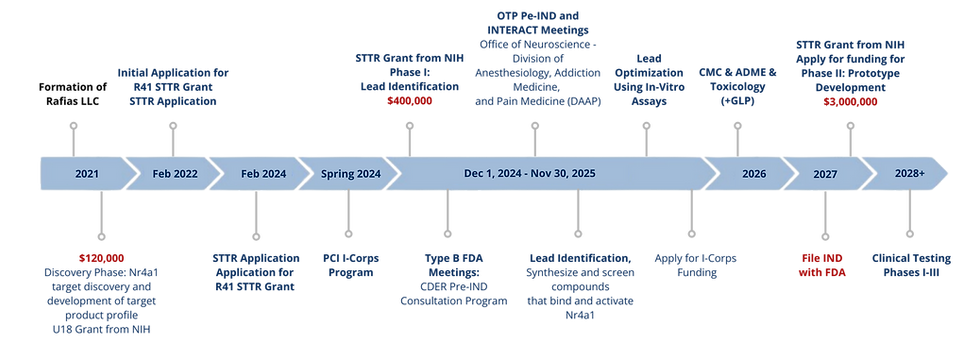
NIH U18 Grant — Target Discovery
Supports mechanistic validation of Nr4a1 as a therapeutic target in addiction, establishing its role in neural homeostasis and relapse biology.
NIH STTR Phase I — Lead Identification
Funds the design and early evaluation of Nr4a1-directed molecules, identifying promising candidates for further optimization.
NIH STTR Phase II — Prototype Development (pending)
Supports optimization and preclinical testing of therapeutic prototypes aimed at restoring recovery pathways during abstinence.
Preclinical Milestones — IND-Enabling Work (in progress)
Advancing pharmacology, safety, and proof-of-concept studies required to prepare for IND submission.
IND Submission (Planned)
Regulatory milestone preceding human trials.
Clinical Trials — Phases I–III (future milestone)
Evaluation of safety, dosing, efficacy, and long-term relapse-prevention outcomes.
Funding & Regulatory Milestones
This timeline outlines Rafias’ non-dilutive funding progress and regulatory milestones from early discovery through IND submission. It highlights secured NIH support, pending grant applications, and the planned preclinical and clinical steps required to advance our Nr4a1-targeting therapeutics.
$400,000
Pending NIH support
$3M
Planned Phase II application
2027
IND Filing Target
